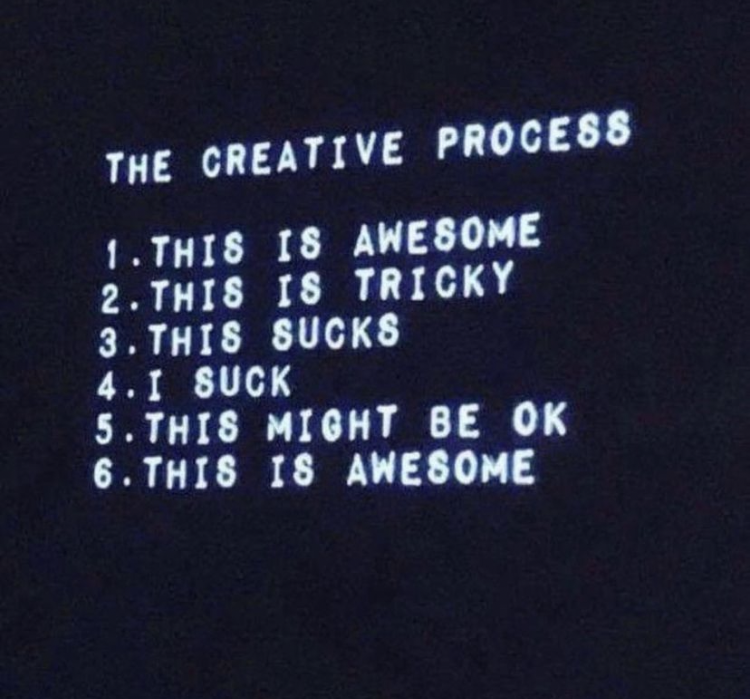
 Creative blocks can be frustrating, but there are several strategies you can use to overcome them. Here are some tips to help you get your creative juices flowing:
Confusion is normal. The creative process include Curiosity, Chaos, and Clarity. Curiosity inspires us to start painting our painting. Then comes Chaos, which is the mess in the middle of the painting. In the end is Clarity, when we see how it's all come together. Be comfortable in the Chaos, even seasoned pros have this experience. Take Breaks. Step away from your project for a while. Short breaks can help you recharge and return to your work with a fresh eye. Embrace Constraints. Limitations can often fuel creativity. Embrace the constraints you face and use them as a source of inspiration. Break Large Paintings into Smaller Ones. How do I manage paintings that are 5 feet by 5 feet, or larger? The answer is that I don’t. I learned long ago that when you’re painting, you’re really only looking at about 12 square inches at any time. So in the end, to paint a 5 by 5 foot painting, I paint 25 12” x 12” paintings. Divide you painting into convenient, bite-size tasks. It makes it much easier. Make sure you have everything you need. The right brush, the right colors, the right lighting, a comfortable chair or stool, room temperature, etc. Take the time to prepare the details of your circumstance to maximize your comfort and enjoyment. Try New Techniques or Tools In the middle of a large painting, take a break to enjoy a small painting exercise. Like doing a 5 inch by 5 inch palette knife painting in say about one hour. Or a painting using only your fingers (I have nitrile gloves). Get free and loose for awhile. Keep it sketchy. Stop taking it so seriously. Remember we’re explorers. Keep it curious and mysterious. Let go of performance anxiety. Come back into the present moment. It’s about the journey not the end product. The point of a dance is not to get to the end of the dance, it is to enjoy being in the dance. The goal of the musician is not to get to the end of the song. The goal of the artists is to be in the creative flow, and the artwork that comes out of that is a bonus. Stop competing with your self. Notice if there is a voice in your head telling you that you must do better than you’ve ever done before. Silence that voice. You’re an explorer, not a contestant. Errors, miss-steps and little so-called failures are normal. They are a sign that you are growing. It’s ok to be normal. Famous Quotes about Blocks and Inspiration “If it is a bigger creative block, I try to ride it out and just let it happen. I will still draw, but most pieces will end up in the trash, and that’s OK. I think some of the biggest bursts of creativity and artistic growth I’ve had are usually preceded by a big creative block.” — Ashley Goldberg “Inspiration exists, but it has to find us working.” — Pablo Picasso “Everyone is born creative; everyone is given a box of crayons in kindergarten. Then when you hit puberty they take the crayons away and replace them with dry, uninspiring books on algebra, history, etc. Being suddenly hit years later with the ‘creative bug’ is just a wee voice telling you, ‘I’d like my crayons back, please.” — Hugh MacLeod “The creativity for you is a place where no one else has ever been. You have to leave the city of your comfort and go into the wilderness of your intuition. What you’ll discover will be wonderful. What you’ll discover is yourself.” — Alan Alda
0 Comments
|
AuthorPatrick Howe Archives
July 2024
Categories
All
|
 RSS Feed

|
Copyright © 2023, by Patrick Howe, all rights reserved.
Patrick Howe, Artist, Author and Educator Seattle, WA. Contact: [email protected] |
|